Denshattack! Review (Switch 2)
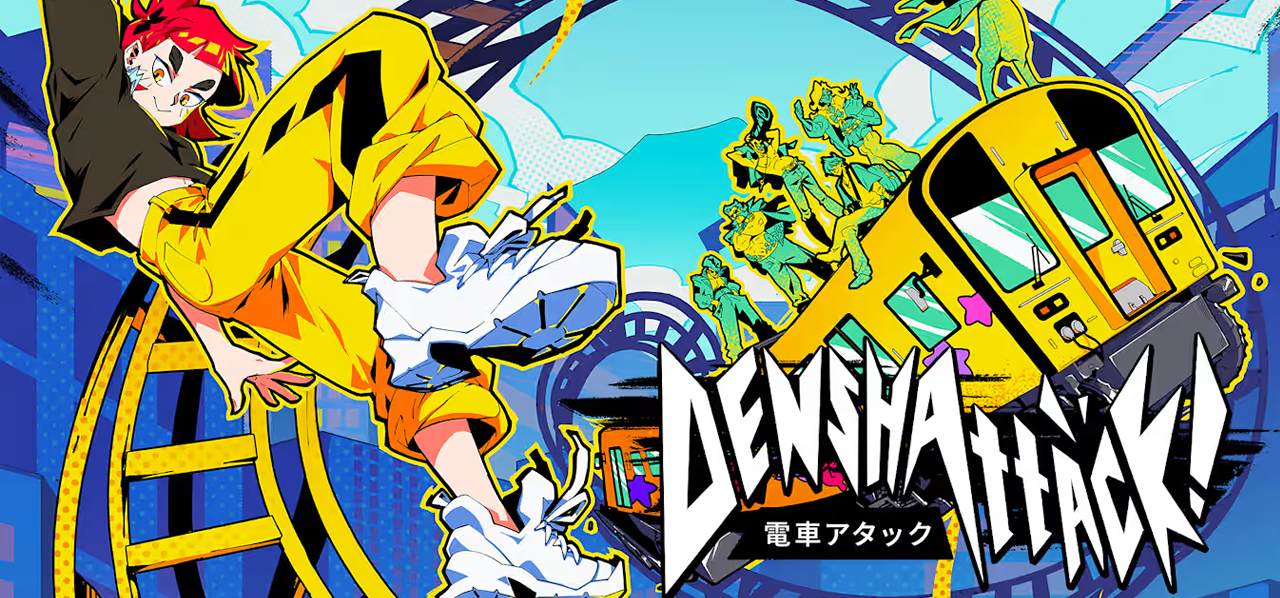
Denshataaaaaack!
Available on: Switch 2/Steam/Consoles
Genre: Arcade Adventure Train Platformer
Publisher: Fireshine Games
You know, with all these games inspired by Jet Set Radio catching my eye I really need to play it. Well, technically this one takes more inspiration from skating games (i.e. Tony Hawk and Skate series), but still. Anyway, this game immediately caught my eye with its trailer and against the inner voice within me telling me that I couldn’t get into similar games. Well, like always, I ended up playing it anyway except this time it was after playing the demo. Which was pretty good. Now, after reaching the credits, was Denshattack worth playing? Or was it best to skip the train ride?

In Denshattack, we jump into the shoes of a young woman named Emi Araki. Emi lives in a futuristic, dystopian Japan where, due to a catastrophic climate catastrophe a few decades ago, pushed the majority of the population into domed cities. This was heeded by a major company called Miraido, who has also developed a supersonic railway system to connect all the domes. However, Emi isn’t someone inside a dome. She’s outside. It turns out that things aren’t that bad outside nowadays and, aside from the abandoned areas that are in various states of disrepair, nature has bounced back.
Anyway, we come in during a normal day in Emi’s life working in her family’s ramen shop as she’s getting ready to do a delivery. Little does she know that this is going to change her life. Emi does her deliveries in her family’s old train and her skill at navigating around despite the deteriorating tracks catches the eye of her customer. It turns out that the man that ordered ramen has a special interest: Denshattack! The man, who you learn is named Fernando, saw Emi in action and he excitedly asks her if she’s a Denshattacker. Upon Emi saying she isn’t and actually has no idea what it is, Fernando tells her what it is (people with incredible train conducting skills competing against each other) and Emi immediately goes to become one. Whether Emi is passionate about skillfully driving her train, just wanting something new to do in her monotonous life, or she usually dives headfirst into new, exciting things doesn’t matter as she just found her calling. And Fernando, who is a freelance photographer and journalist, just found his muse.
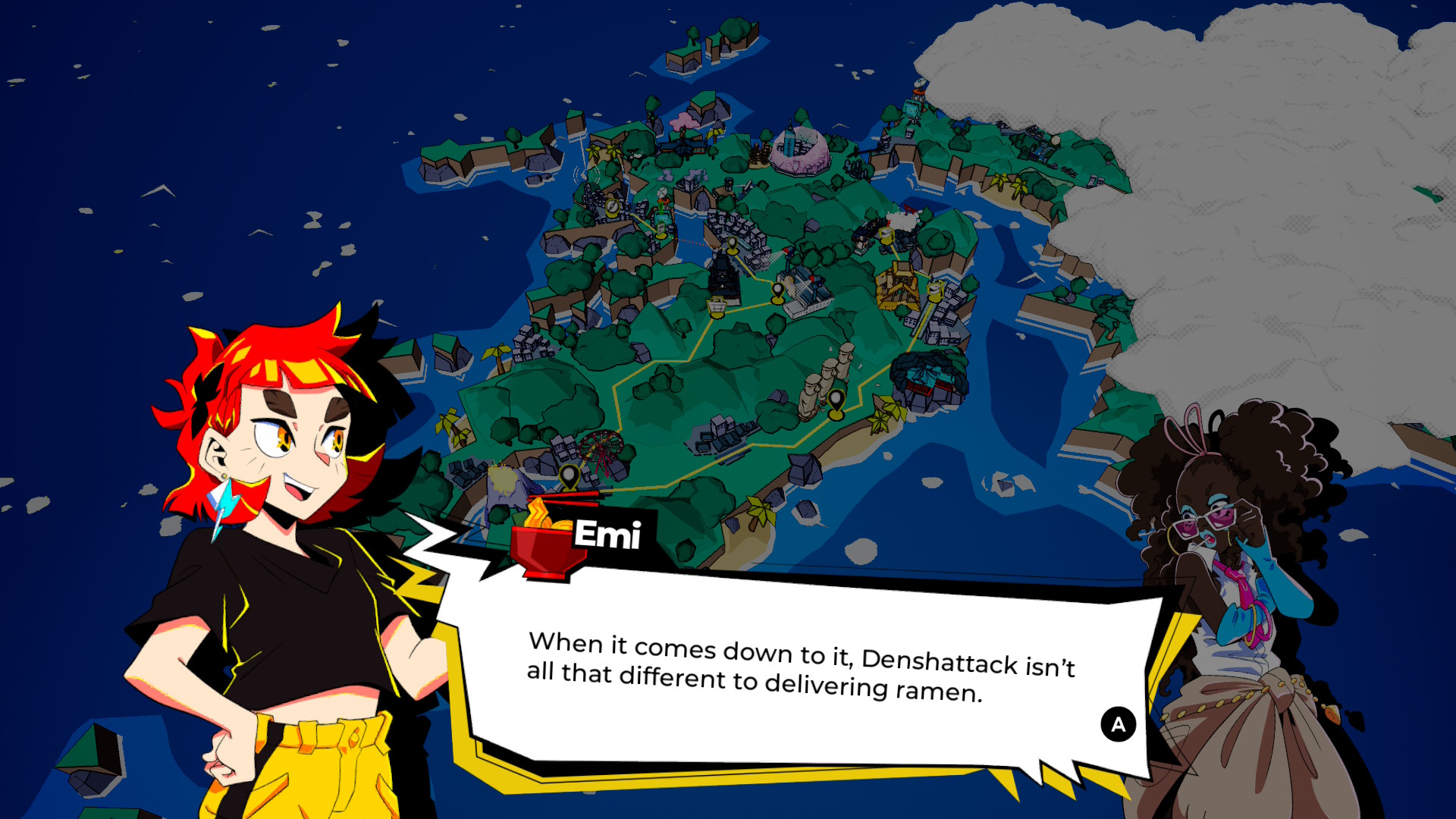
Throughout her journey across Japan, Emi will hone her skills as a Denshattacker, go up against the various Denshattack gangs, accidentally make some friends and her own gang, and go up against the man. Between chapters, we also get to see a short and sweet Miraido news broadcast that’s framed as being aired in the domes; which gives us a bit more information about this version of Japan and a little sneak peek at locations you’ll be tricking at.
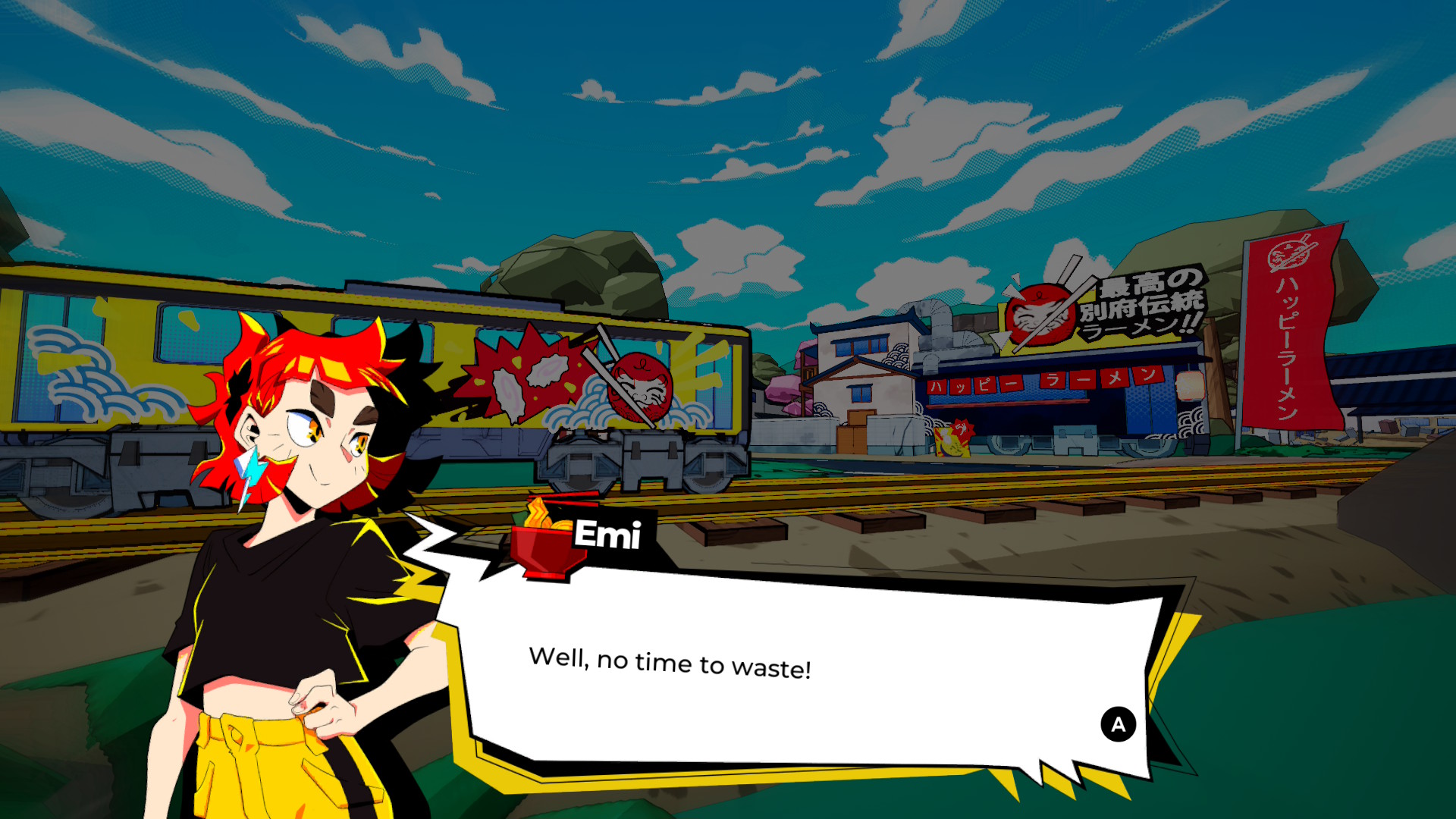
The story here is alright. I do think it starts out pretty good as I did really like how Emi was just so enthusiastic about Denshattack and wanting to go up against everyone she could. I do still wonder how she didn’t know about it considering how widespread it is, but I did really like Emi’s character being a daredevil, confident airhead. I also liked Fernando, being someone who is so passionate about Denshattack, despite not being a Denshattacker himself, who wants to share his passion with others. Overall, I just liked most of the characters you’ll be interacting with and I really liked how character focused it was in the first half, with the stuff concerning Miraido and the domes being in the background and hinted at. However, the latter half ended up disappointing me. The game’s story goes in a very predictable direction that you can guess right out of the gate. I guess that means I should have expected it, but on the other hand I liked how it was written in the first half of the game and thought we would be getting more of Emi and Fernando’s backstory.
To me, it felt like both halves of the game clashed against each other and this type of game just doesn’t pair well with what they were narratively trying to go for. It also doesn’t help that I didn’t like the way the game transitioned into it. While you get the odd cheeky comment thrown in here or there, the game doesn’t really lead you up to it. I also didn’t like the character that kickstarted it. I don’t like characters (and people) that act like they’re the only one that suffered and no one can understand it cause it’s only happened to them; and I especially hate how none of the characters say anything. Especially since you do get hints at Emi’s and Fernando’s backstories and lore on the gang leader’s backstories. Not to mention that he ends up being very hypocritical. I was waiting for them to be like “no dude, we experienced that too” but they don’t. Then most of the characters (including future ones you’ll meet after him) get pushed to the side in favor of the political commentary that I don’t think was well done here. It also is the start of the game becoming more mean-spirited and there are points where the characters feel out of character.
I guess what I’m trying to get across is that the first half made me think that it’ll focus on the characters, but that falls to the wayside once you go to the second half where it suddenly decides that it needs to actually tackle the things it briefly brought up as worldbuilding. I think it would have worked better if Emi was instead intrinsically motivated and you learn how it is inside the domes from Fernando, but I guess since those hints were in optional conversations I shouldn’t have expected it to come back around. I’d say the story is easy to just go along with it, but I couldn’t due to personally not liking the direction they decided to go in with the narrative. I went from not getting enough of Denshattack to waiting for it to finally end.
Not to mention that the longer the game went on narrative wise, the more the holes in the narrative became apparent. Like, how are the domes so easy to get into? Why do at least half of the domes seem abandoned? Why is Miraido so slow to dismantle every transportation option aside from theirs at least around the domes?* Are the people in the domes actually unhappy? How is life in the domes? How much time passes in-game? Is everyone riding in their own trains or are they riding in the same train aka Emi’s? And more questions that are more spoiler-y. A side effect of focusing on the political commentary is these aspects of the game coming into question where before you could just handwave it as rule of cool (as it is cool when a level transitions inside a dome).
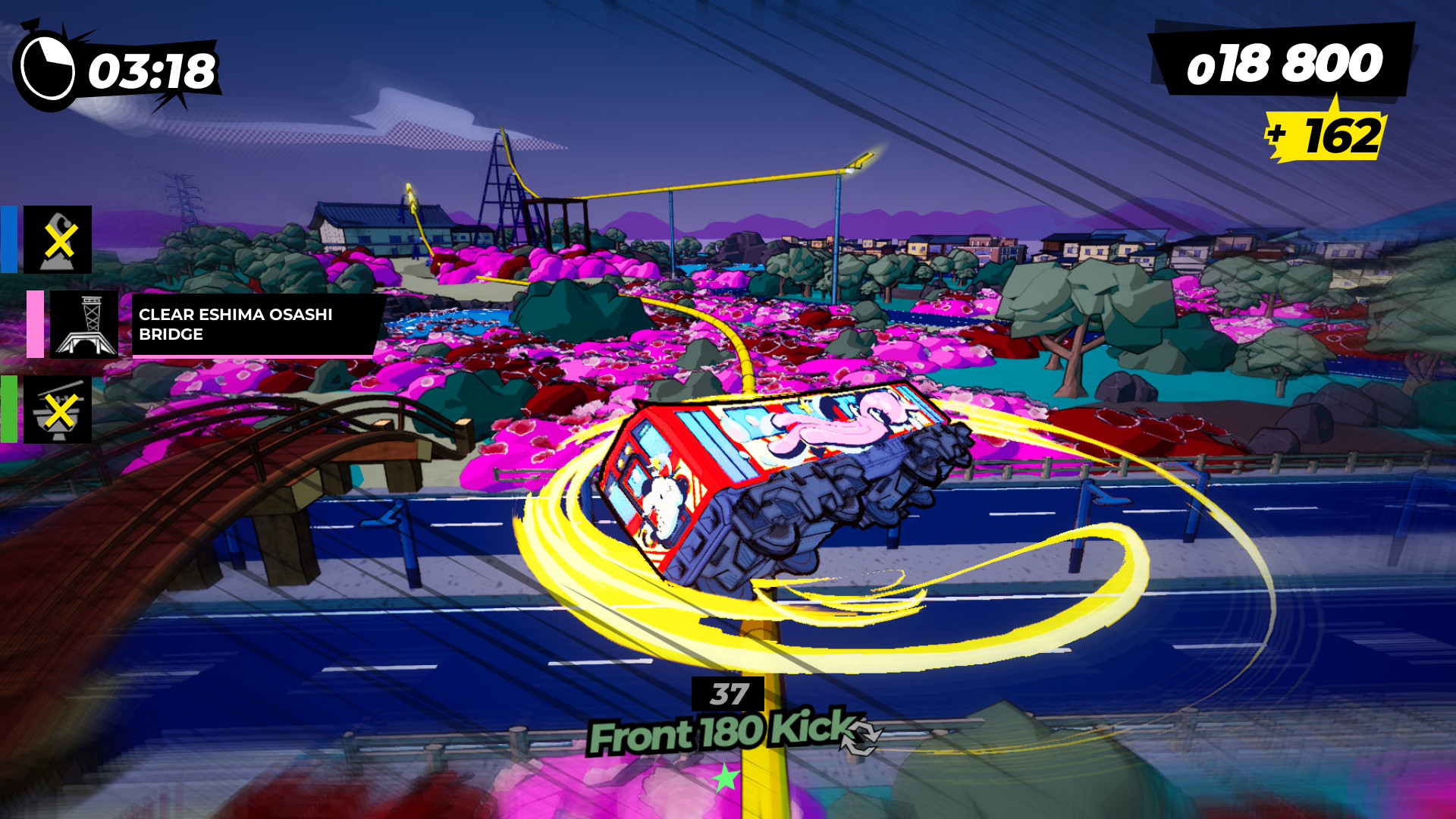
Now onto the most important part of the game: the gameplay! You’ll be traveling across Japan, region by region, prefecture by prefecture, and level by level. Don’t worry though, things are going to fly by once you get your hands on the wheel. There are two parts to the gameplay here: traversal and tricks. First up is traversal, which I’d say is important considering you don’t want to crash. Denshattack will have you controlling a train the whole game and it actually is pretty easy to pick up. A level will always start with you starting the engine after the countdown. Most of the time your train will be traveling on tracks that has been placed throughout Japan before the climate catastrophe. These don’t come up much in levels, but you do have a horn and a break that you can utilize. You will be going at fast speeds so a lot of the corners will cause the train’s center of balance to be off. If you let it be, your train will derail so to counteract that you’ll drift around corners! All you have to do is make sure you press the button and release it when the meter is in the green. You’ll also come across junctions which you’ll have to choose which way you want to go. However, this is where the fun begins as, due to things deteriorating and falling down, you will find yourself driving headfirst into hazards. Thankfully, Emi’s train is able to jump and safely land on the tracks (especially since there are ramps you have to take). Even if you have to make a sudden air stomp if there’s a hazard in your way mid-air. There will also be times where you have to switch tracks due to hazards like there not being tracks anymore or something on the tracks blocking your way. Oh, and there are also speed boosts which help speed things up.
Seems easy enough, but that’s only the basics as more mechanics and by extension more level elements will be added to your arsenal as you progress through the game. Not everywhere will have good tracks for your train to utilize so you have to make do with what the environment gives you. Rails will come into play and you have to learn how to grind on them, which is keeping balance (indicated by a meter you have to keep the cursor out of the red) so you don’t fall off while and learning how to balance well, balancing and tricking (which messes up your balance). You’ll learn how to wall ride, which translates into alternate versions of it, and once you get the hang of how the movement controls change you can also do slide tricks. I won’t spoil the other mechanics, but I will mention Yaoyorozudo or rainbow roads as I like to call them (though technically it also manifests as walls or rails) that you’ll be able to see after you fill up your trick meter. Being framed as Emi getting in the zone, these rainbow roads will allow you to take different paths which can be faster or take you to a different part of the level map. Not every level will have this, but for the ones that do it is best to try and fill it up as quick as you can.
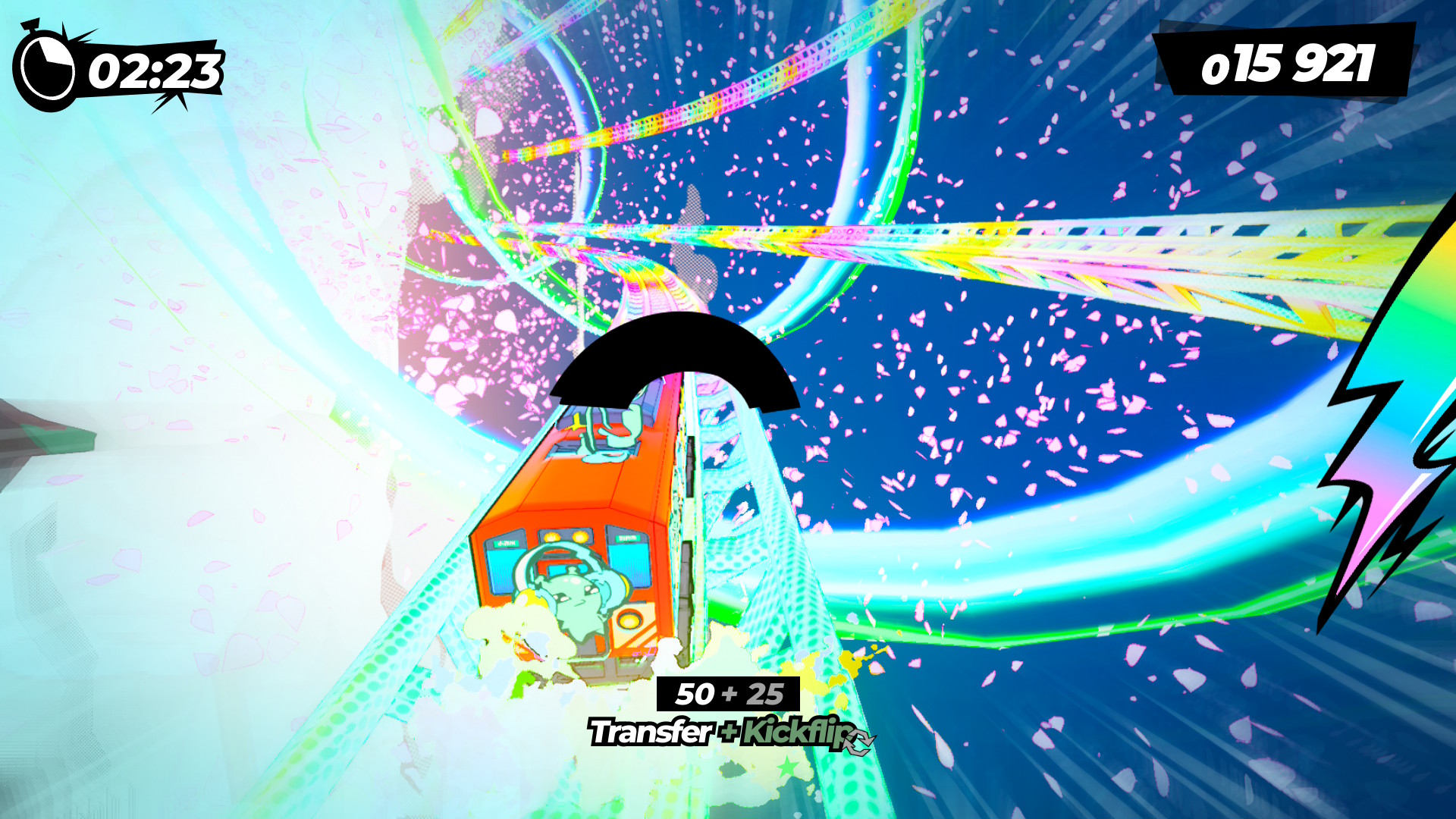
Don’t worry if you do crash, while you might not make the best Time, the game does quickly put you right back into the action.
Of course, you can’t forget about the tricks. This is more straightforward than traversal but equally important. Whenever you’re in the air or riding on anything that isn’t a train track, you’ll be able to do tricks by moving the thumbstick in various different patterns. Tricks go from basic to hardcore, which is determined by how complicated the trick is to do. All the tricks basically come from the basics that the game teaches you in its trick tutorial and you can check out all of them in the Tricktionary. The more complicated the trick, the higher score it’ll grant you. You can do any of the Tricktionary tricks when you’re midair and doing multiple will chain them together in a combo. You do also learn later how to keep the chain going for longer, but the combo completely cancels out if you crash before all wheels are on the tracks. In addition, the other surfaces that you’ll find yourself on (rails, walls, etc) do also have a basic trick that you can do to get some more points and this will also keep your combo chain active as well as adding to the combo. However, you do need to have variety in the tricks you do. If you keep doing the same tricks it’ll give you less points (which this is indicated by the trick counter on the bottom of the screen greying it out and putting a loop symbol under it). Oh, and the game does also have risky dodges, which basically you dodge at the last second, which will give you some bonus points too if you manage to pull it off. Tricks can be a bit hard at first, with getting the timing, combo chaining, balancing, and variety down and all, but if you want those sweet high scores you’ll have to master it.
There are five different types of levels that you’ll be playing through. There are the normal levels which simply require you to get to the end (and by the way the end will have different boards that will give you some extra points depending on which one you break); races that challenge you to getting in the Top 3; time limited levels that you have to hit the score requirement before the time runs out (you can get overtime if you’re mid-combo); objective levels which you’ll be asked to complete at least three objectives and you can stay in it for as long as you want; and finally boss levels which you’ll obviously be battling it out with that region’s gang leader. In addition, objective and time limited levels are more open area levels as there’s no linear path here for you to follow. This does mean you have free reign and can do objectives in any order, but it can be hard to have variety in the paths that you take. Which in turn can make the Dares hard to do.
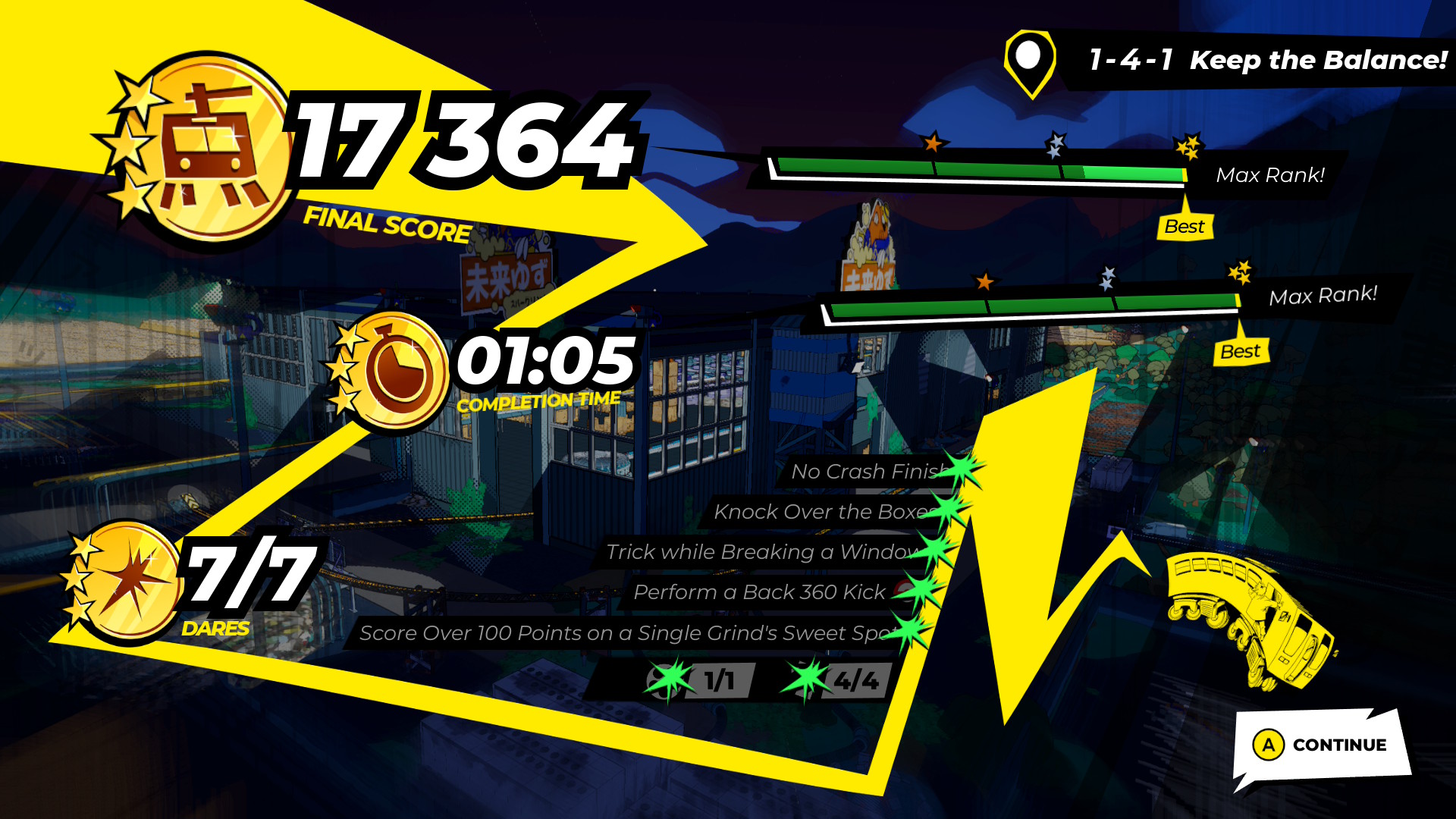
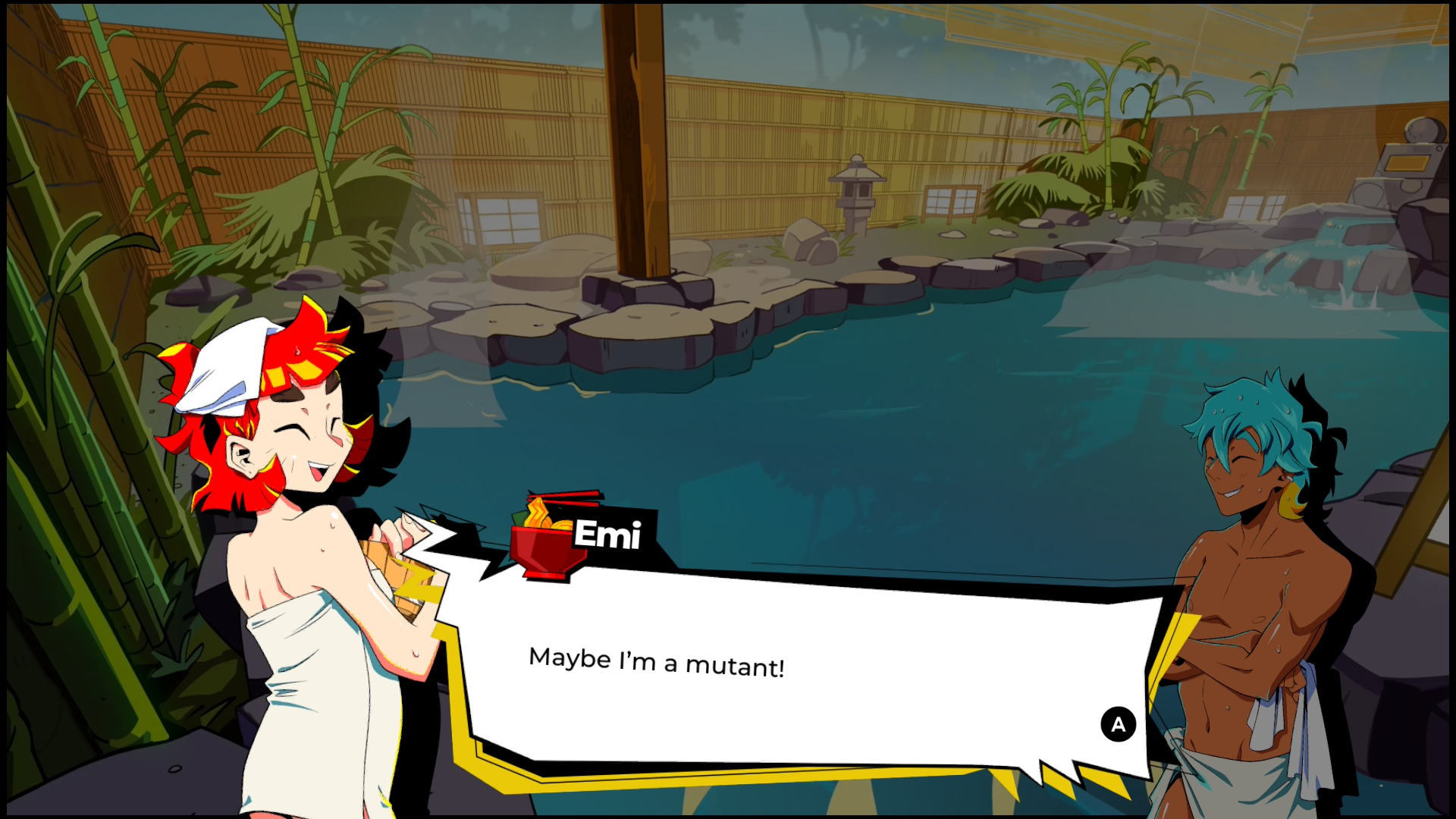
There are a lot of optional things you can do here, which can be summed up easily as just aiming to get gold models for all of the levels. Every time you finish a level, you are scored in three categories: Score, Time, and Dares. The first two are self explanatory as you’ll get medals based on how high your score is and how quickly you go through the level; with each level having its own milestone for the three different medals. That just leaves Dares, which are basically optional things you can do in the level. Dares are made up of 7-8 points, with 5 of them being taken up by optional objectives. These optional objectives are mainly unique to its level as you’ll get objectives that are either trick based, traversal based, or a mix of the two. Like tricking during a specific part of the level or passing through specific tracks on the map. Most levels do have a “No Crash Finish” Dare and a handful of levels also feature two exits in the form of an Onsen Exit. The Onsen Exit will unlock the onsen for that area and there you’ll get three topics for the characters to talk about which can allow you to get to know these characters a bit more.
The other 2-3 Dares are the collectibles. These collectibles do actually have a use and some of these can be quite hard to find as there are some sneaky turns or paths that you can miss (especially in the more open levels as it is very easy to keep going on the same path). There are three collectibles that are placed in the levels: film rolls, paint cans, and gears. Film rolls are a bit misleading as the icon in the UI is a film reel while the overworld icon is camera film and in-universe Fernando takes a photo. These are used to build the fanzines for each area. Each film roll you collect correlates with a section in the fanzine which can be either just a photo or illustration to a written segment that is framed like Fernando wrote it himself. I quite liked reading the fanzines as they give you some nice information and backstory about the characters in the local gang that you meet, a blurb on that area’s history (both before and after the climate catastrophe), blurbs about the local culture and the trains the local gang drives, and then a feature about Emi’s journey written in Fernando’s perspective. In addition, each fanzine is also themed around the gang that resides there. The aesthetic and layout changes each area and this really allows for some great variety, makes each fanzine feel unique, and gets you to look forward to what the next one will look like. I loved reading the fanzines as they were all really interesting and I can definitely see why it became popular in-universe.

Anyway, paint cans are used to buy different stickers for your train. Stickers give you more spray painted designs for your train that you can equip to give them more pizzazz since other than that you have limited color schemes and patterns for trains. Lastly, gears are used to buy different trains. Yep, you will be able to use other trains aside from the one Emi starts with! These trains not only look different and have different color schemes and patterns, but they also give you a reason for buying them through their perks and drawbacks. The vast majority of trains in the game will have a perk that corresponds with a playstyle or aspect that you may be weak on, but will have a drawback so it isn’t overpowered. Like a train can make grinding easier, but lower the score you get for example. Some even lean into the high risk high reward category. The narrative does treat you as using different trains, but you can easily just use the first train when you’re going through the main story. Each new area will add new stickers and trains in the shop.
On that note, there are a bunch of creator codes that you can input, and two general codes. These codes will add stickers themed around that creator (the two general codes are based on the game) and most also add in a new announcer voice which the creator voiced. I personally recommend looking up what these look like before inputting them as they do clutter up the menu. I also ended up staying with the default announcer voice. Granted, I also personally only watched two of these featured creators before and like designs that are more subtle in their connection to a creator.
While you won’t see the medal requirements for Score and Time before starting a new level (though you can see the requirement for the next medal if you’re going to replay it), you can see the Dares before heading in. The overall medal for each level is determined by the average of all three medals. I wouldn’t worry about getting all the gold medals. The game doesn’t expect you to do everything in one go as the game will keep your highest score and will cross off Dares you already did, with the final medal total using your highest score/time. Plus, in the beginning you don’t know some of the mechanics that do help you score higher.
I honestly really enjoyed Denshattack’s gameplay. I was a bit hesitant to pick this up as, like I said before, I couldn’t really get into the skating games that inspired this game. However, this game looked really fun in gameplay footage and I was able to play the demo which I liked. Then the Trickpark worried me again haha. Well, I’m glad I ended up playing Denshattack as I ended up loving the gameplay. In fact, I was a bit addicted to it and just like Emi, all I could think of when I had to take a break (either to charge my Switch or to do other things) was Denshattack. This game feels so amazing to play due to the combination of the (mostly) responsive controls and the exhilarating feeling you get while playing. This game is very fast paced both in the fact that most levels are a handful of minutes long, how fast the train itself gets letting you speed through levels, and how quickly you’re thrown back in if you crash or restart. On that note, I do think the game does a good job overall with giving you enough warning before you have to jump or drift or whatever else. There are a few sneaky branching paths or hazards that are hard to react to or even see due to how fast you’re going, but that’s it. Most of the time when I did crash it was a mistake on my part. Honestly, the only thing I had trouble with was having variety in my tricks and going down different paths in the open area levels.
I do think a reason why I was able to get into Denshattack, and not the other games in the same vein, is how the controls were implemented. I liked how train movement was dedicated to one thumbstick, tricks dedicated to the other thumbstick, and any other actions being a trigger or face button. That and the vast majority of the time you’ll be sent up into the air by the level. While you sometimes have to do a charged jump, for the most part you don’t have to worry about needing to do something else too. I guess in a way, Denshattack streamlines aspects that may have been the reason why you may not have gotten into other similar games.
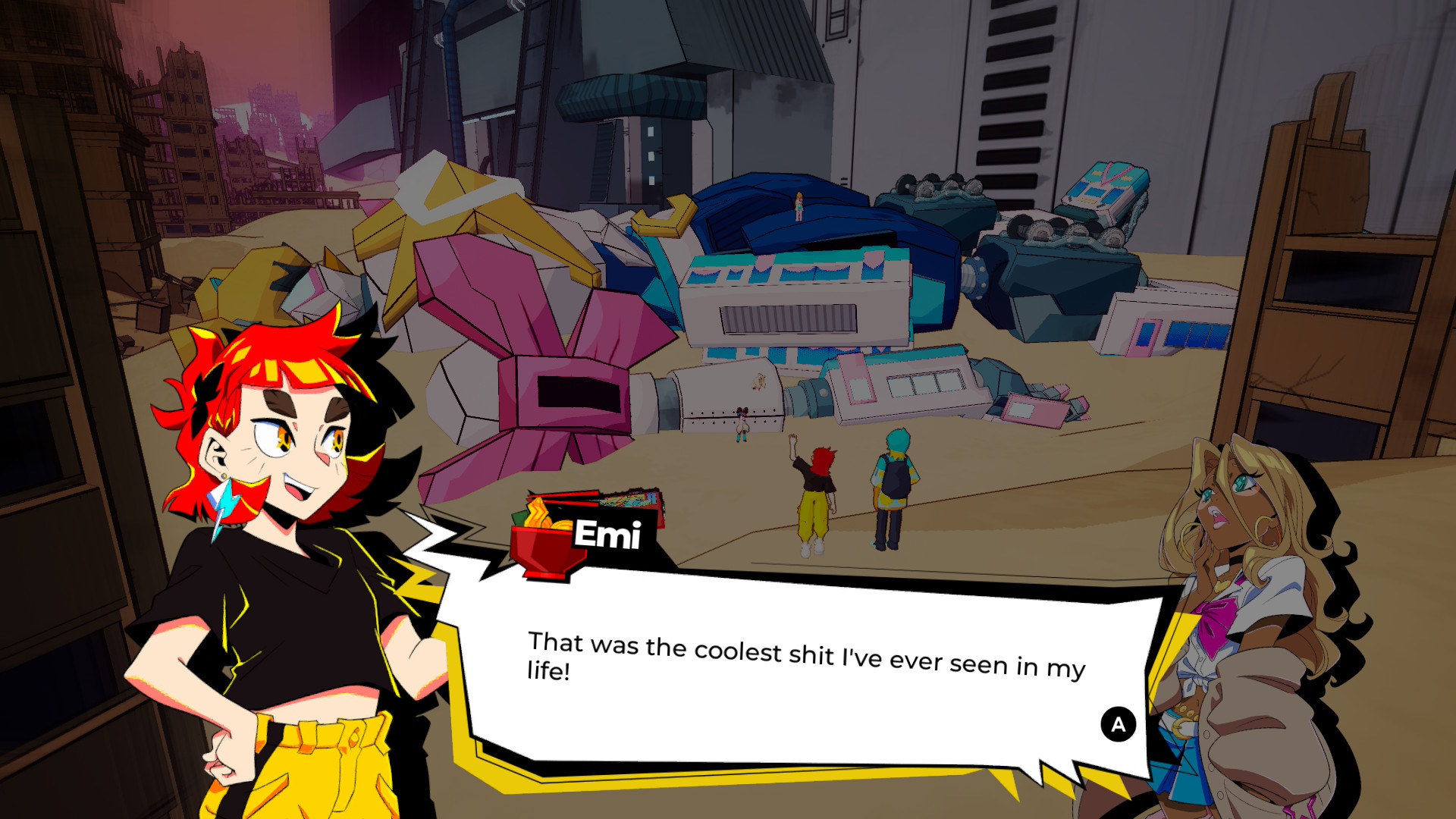
Oh and I can’t forget how crazy the levels are. The levels are crazy here and Denshattack certainly doesn’t leave you with any boring moments gameplay-wise. It certainly keeps you guessing with what to expect and it gets you wanting to play the next level to see what else the game has in store. As you can guess, the level design is great here and they certainly make full use of its dystopian setting.
I also think this game does a great job with introducing new mechanics. It starts you off with the basics, making sure you have those down, before adding more to your movement arsenal. When the game does introduce you to a new mechanic, it does well in explaining it in a short and sweet way in the tutorial tooltip and it dedicates a whole level where that mechanic is the main one. By the time you finish the level, you’ll have that mechanic down so after that it incorporates that mechanic into future levels. All the different mechanics are easy to get the hang of and execute them at high speeds. Not to mention that it does pretty well in having you feel like you’re getting better. Even if you’re like me who knows they’ll be horrible scoring-wise, you do get more confident. Like, I didn’t do grind tricks in the beginning, and in fact found it crazy when I saw someone else constantly doing grind tricks, but the more I played the more confident I did get and I ended up doing a lot of grind tricks since I understood the mechanic more. I also got better at keeping my combo going. I still was horrible at scoring, but I did feel like I was getting better as I played more.
So, yeah, I really enjoyed the gameplay here. This game is as fun playing it as it looks watching it.
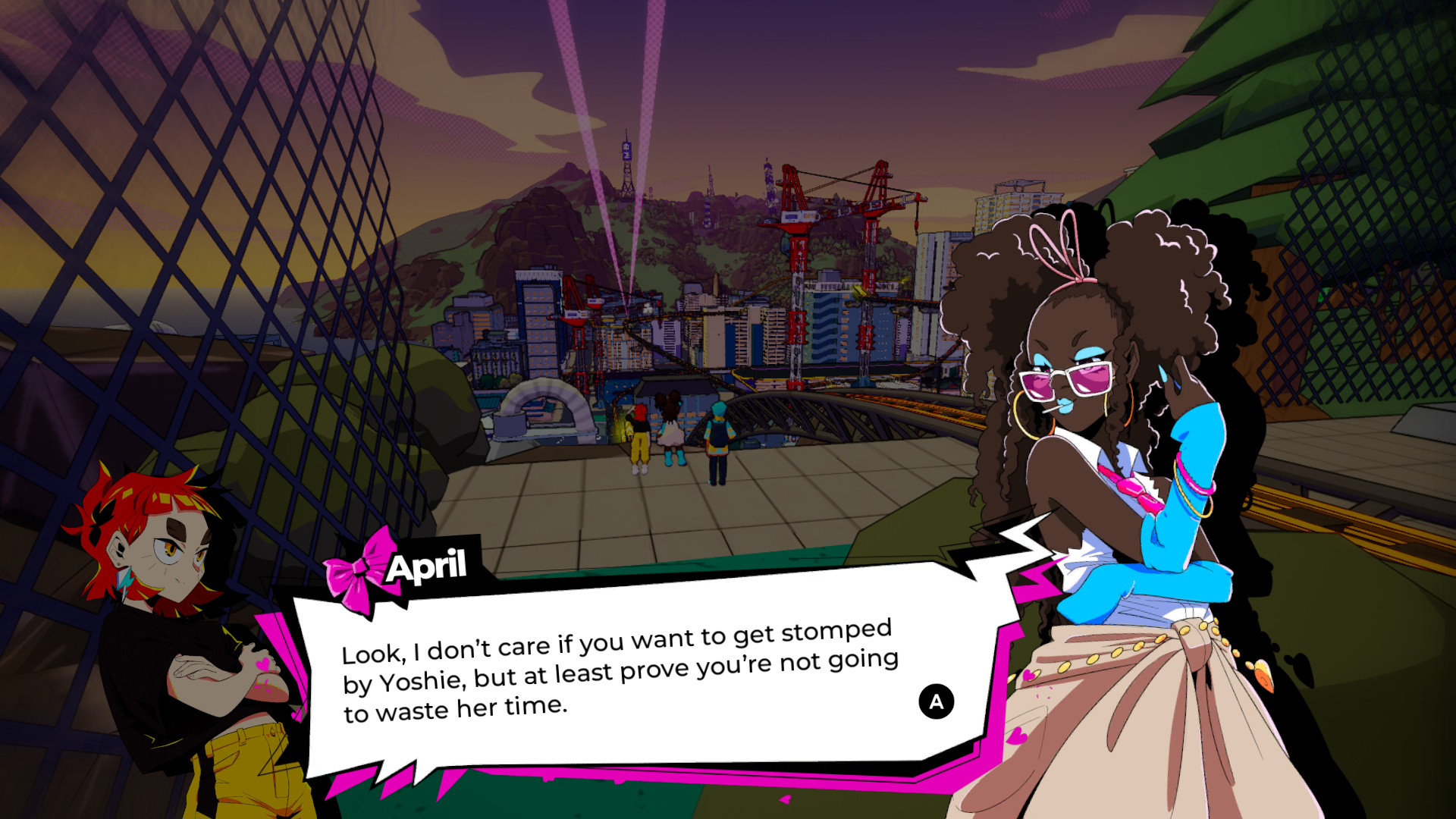
Sadly, I did end up having a couple of complaints against Denshattack. Aside from my gripes with the narrative, I did wish that you could see the requirements for the different Score and Time medals. The performance here is beautifully smooth, but I did have a handful of moments where the game didn’t spawn me on a track after crashing (causing an immediate crash), a couple moments where hitboxes felt or were off (there’s a late game level where you can just phase through the model since the hitbox didn’t extend fully), a couple weird interactions with the train and map, and a good handful of moments where I felt the train wasn’t responding to the left stick to move tracks, wall ride, or manual (this includes the couple times during tunnel/wall rides where it got stuck on a direction, no matter if I was pushing the left stick the other way, until the train crashed). This can make some No Crash Finish runs annoying since it wasn’t due to my own inputs. I wished you could go between levels with the directional pad, like acting as a way to go between levels in order, as some spots are hard to select with the thumbstick. There are a few times where a collectible was collected without being near it (in a sense that I was on the path underneath it) but I can’t complain since it did get me a film roll collectible I was having trouble with. I didn’t mind this, but I did find it weird the normal levels don’t have a minimum score requirement considering Fernando tells Emi she needs to reach the goal on time with minimum amount of points in the first actual level of the game. I wished there was a spot where you can look at all the fanzines without having to go all around the map. Lastly, I have to admit, the game does start to feel like it’s overstaying its welcome sometime during the second half of the game.
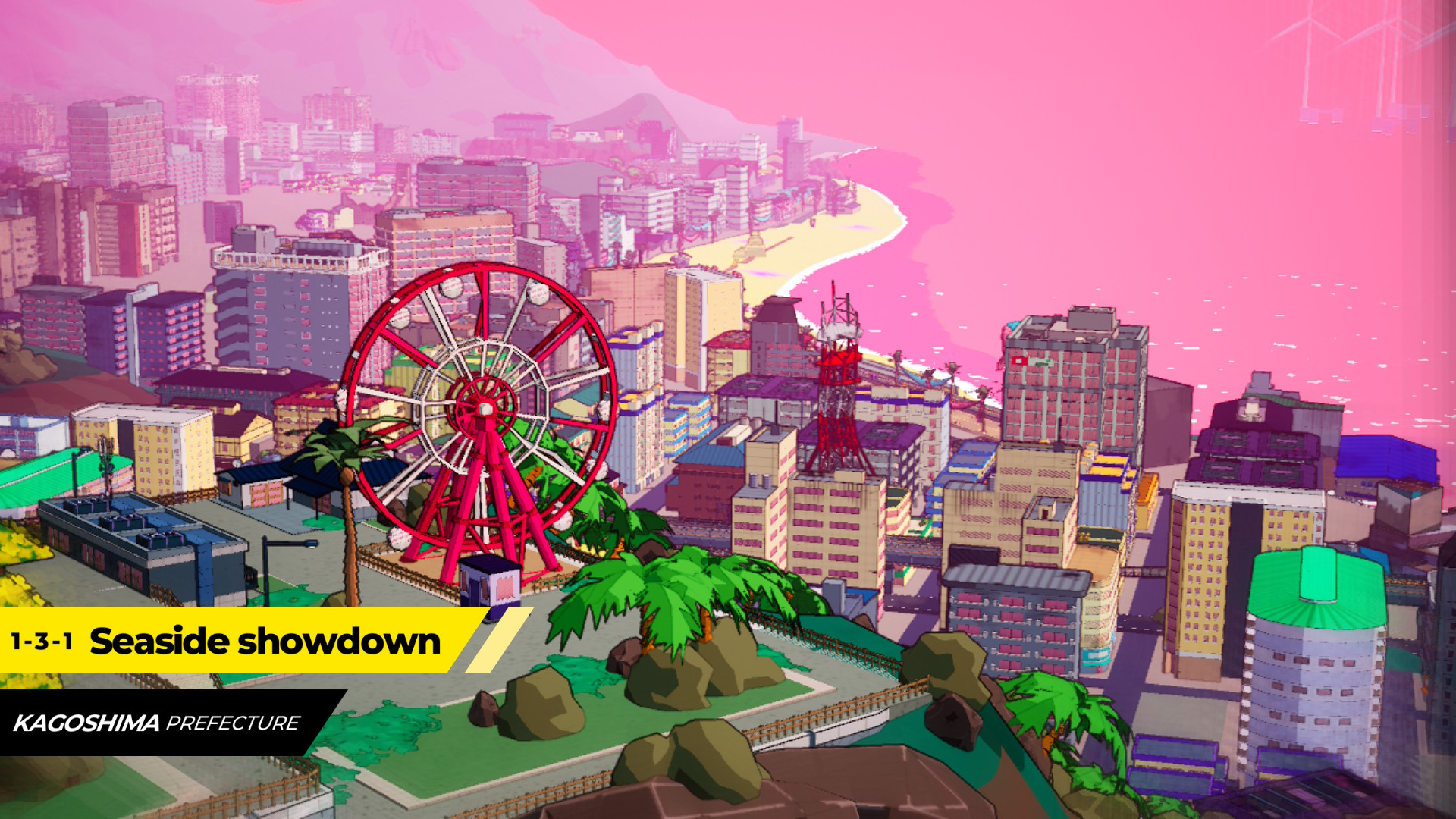
To tie this all up, the visuals and sound here are great. I loved the aesthetic the game went for with how colorful the game is despite its dystopian setting. I liked how each area has its own unique landmarks and how the state of everything varies depending on where you’re at. This also helps with the level design as it is pretty fun to be traveling on ruins. It was a great choice in having the environment match the anime-esque aesthetic as I don’t think the environment would be as stunning if it was realistic. Everything is also very clear despite how fast you go and I had no problem reading the various elements of the level. And on that, I did like the character portraits and cutscenes. Of course, there are some character designs that I was a bit meh on, but I liked the art style the game went for. I also liked the various train designs as well as the various stickers and patterns. There are also some nice small details here like the loading screen adding characters as you progress through the story (though I still think it’s a missed opportunity that we didn’t get an alternate loading screen for the part of the story where they’re not with you), the little textbox shadow effect that matches with their gang affiliation, and how each fanzine is themed around the gang local to that area. Heck, Fernando’s fanzines are definitely the best as he put in so much variety between each issue both in the layout, theme, and illustration art style. When you think about the gang in your mind, it is definitely what you imagine.

Sound design wise, it’s actually really good. The sound effects of the train during its various moves are just right, helping it feel impactful just like how it looks visually, and the little alerts you get of upcoming hazards have a nice sound effect that weirdly is calm but is high pitched enough that you catch it (which sounds weird but it helps considering you’ll be hearing it a lot). I also loved the music. The vast majority of the track is gold (I only disliked two songs which was towards the very end of the game) and they really help sell how exhilarating it must be to be in the train and it really helps sell that feeling as you’re playing. It really hypes you up while playing and ready to do some crazy tricks. It also does well with the tracks meant to be downtime (like the track that plays on the map level select or during cutscenes) as it does have that “taking a break” vibe with a touch of “I’m rearing to go whenever you want to”.
Though, personally I found the voice acting to be okay. I liked the announcer voice and the voice line barks for the unvoiced lines, but the voiced lines were a mix bag for me. I also appreciate how the chatter during levels was voiced cause man it’s even hard to even get a quick glance at the character portrait of who’s speaking sometimes.
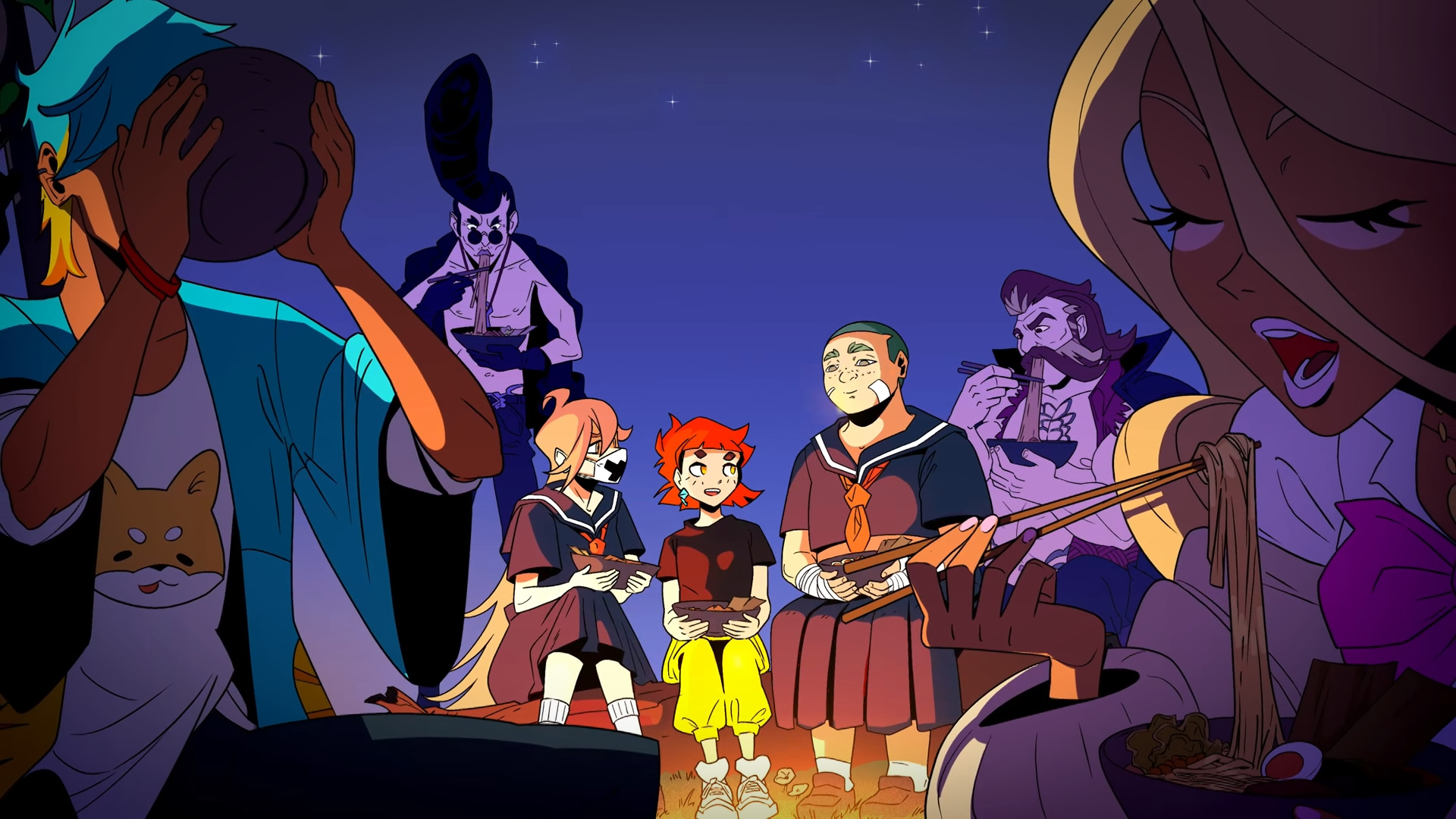
Verdict
Denshattack is a game that starts out strong, but does slowly lose steam towards the end. Despite my complaints towards the direction the narrative went down and some gameplay aspects, I had a lot of fun with Denshattack and I couldn’t stop playing. It turned out to be a really approachable, fast-paced arcade game that was easy to get the hang of things, read the environment and catch warning signs at high speeds, and easily has that “just one more level” effect. While you will get the most out of the game if you’re someone that will aim to get all gold medals, I’d say this is worth picking up even if you’re only going to play levels once or aim for collecting all of a specific collectible (may I suggest film reels). Not to mention that the game nails its level design, aesthetics, and soundtrack. So, yeah, Denshattack is an easy recommendation just for the gameplay and crazy level (and boss) design alone.
If you’re someone that also couldn’t get into similar games, I’d say there’s a chance you will enjoy this one. I really enjoyed Denshattack despite this myself and the only explanation I can think of is that the game is designed so you don’t really have to think about it, if that makes sense. Not in a “on rails” (heh) kind of way but a “this is one less thing to think about in a sea of mechanics and tricks” kind of way and I do think the fast-paced nature of the game really helps out too. It’s a bit hard to explain as it’s more of a feeling.




Recent Comments